
Ruffle Brush
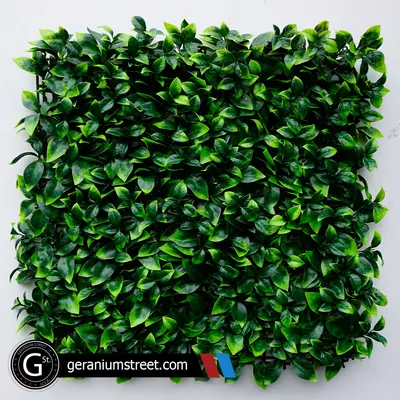
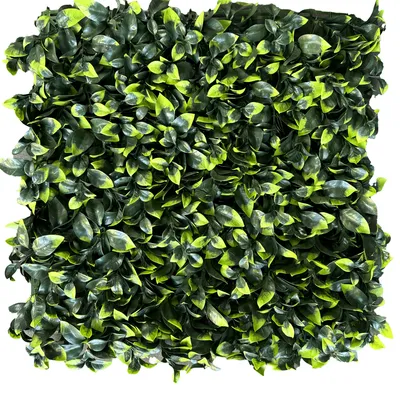
Textured ruffle brush foliage adding dimensional interest and softness to living wall compositions.
- Ruffled, brush-like textured form
- Adds dimensional softness to flat walls
- Works as filler and as accent highlight
- Blends with ficus, fern, and boxwood mats
- Attaches with zip ties, wire, or staples
- Hides seams between mounted panels
- Best used in small, deliberate quantities
- No trimming, watering, or fertilizing
Ruffle Brush is an accent element, built for texture rather than coverage. Its foliage gathers into soft, ruffled tufts — a brush-like density that catches light differently than a flat leaf mat and adds a layer of dimensional softness where a wall composition would otherwise read uniform. Think of it as a finishing note, tucked between panels to break up a plane.
In a mixed living wall, the ruffle's feathered edges interrupt the repeating grid of leaf mats and lend the surface a hand-arranged look. It works as a filler that fills the small gaps and seams, and as a highlight that draws the eye to a pocket of extra depth. On its own it wouldn't clad a wall; alongside other foliage it makes the whole composition feel planted rather than tiled.
The brush form suits interior feature walls and designed installations where texture variety matters — reception backdrops, boutique retail, restaurant niches, and event sets. Use it sparingly and deliberately: a few ruffle accents worked into a field of ficus, fern, or boxwood do more than a wall built entirely from one texture.
Ruffle Brush installs as an accent, not a base layer. Tuck the tufts into the gaps between mounted foliage panels and secure them to the backing or to the mat structure with zip ties, wire, or staples so they sit flush and can't work loose. Because it's a filler, build the main wall first, then place ruffle accents where seams show or where a pocket of extra texture will read best.
Work in small quantities and step back often — the effect comes from restraint, not saturation. For California living-wall projects that incorporate ruffle accents, Califauxscapes can design and install the full composition under CSLB #955154; elsewhere the brush attaches easily alongside your other panels. An occasional rinse or gentle shake clears trapped dust from the tufts and keeps the texture crisp.
- Seam filler between living-wall panels
- Texture accents in mixed foliage walls
- Reception and lobby feature backdrops
- Boutique retail display detailing
- Restaurant niche and shelf greenery
- Event and photo-set accenting
- Designed biophilic interior installations
- Highlight pockets in green-wall compositions
Choose Ruffle Brush over a full-coverage panel like the Lush Long Leaf Mat when you want a textural accent rather than a wall's worth of foliage. The long-leaf mat is a 20-by-20-inch interlocking panel meant to build the bulk of a green wall; the ruffle brush is a filler that dresses the seams and adds a pocket of softness the flat mats can't produce on their own.
It also plays a different role than the Ficus Leaf Mat, which lays down broad tropical coverage as a primary surface. Pair them: mount the ficus or another mat as your field, then work ruffle brush into the transitions to hide seams and vary the texture. Use the mats for area, and reach for the ruffle brush only where the composition needs a hand-arranged finishing touch.
Can I build a whole wall from ruffle brush?
It isn't meant for that. Ruffle brush is an accent and filler element — it adds texture and hides seams within a wall built from full-coverage mats. For the main surface, use interlocking panels like the Lush Long Leaf or Ficus Leaf Mat, then work the ruffle brush in for detail.
How does it attach to the wall?
Build the main foliage wall first, then tuck the ruffle tufts into gaps and seams and fasten them to the backing or panel structure with zip ties, wire, or staples so they sit flush. Because it's placed by hand, add it in small amounts and step back to check the effect.
What does it pair well with?
It blends into mixed compositions with ficus, fern, boxwood, and long-leaf mats, softening the repeating grid and adding a hand-arranged look. Use it where seams show or where a pocket of extra texture will draw the eye, rather than spreading it evenly across the surface.
Does it need any upkeep?
No trimming, watering, or fertilizing. The ruffled tufts can hold dust over time, so an occasional rinse or a gentle shake clears them and keeps the texture crisp. Indoors, a periodic dusting is usually all it takes to keep the accents looking fresh.
Add the texture a flat wall misses
Tell us which panels you're building with and where the seams fall, and we'll quote the ruffle brush accents to finish the composition.
Request ruffle brush pricing