What hedge covering can do
Change the visible finish, add visual screening, unify mismatched surfaces, support a branded or hospitality look, and reduce reliance on live planting maintenance.
Use artificial boxwood or hedge products to change the visible face of an existing chain-link fence, wood fence, metal fence, masonry surface, barrier, or gate—without pretending the greenery repairs the structure beneath it. Product format and attachment are reviewed separately for the actual substrate, exposure, movement, access, and project requirements.
Start with photos, dimensions, substrate, exposure, and gate details. The planner below organizes those inputs before you inquire.
Everything here is about covering an existing fence, wall, barrier, or gate with artificial greenery. For flexible-mat case planning, see boxwood hedge mats; for freestanding privacy hedges, see boxwood hedge systems.
 Los Angeles security-gate project · 360 sq ft
A fence-covering project adds product, attachment hardware, and wind area to an existing condition. The visible greenery and the supporting structure should not be treated as one interchangeable specification.
Change the visible finish, add visual screening, unify mismatched surfaces, support a branded or hospitality look, and reduce reliance on live planting maintenance.
Repair weak posts, correct damaged rails, certify anchors, increase gate capacity, provide complete privacy from every viewing angle, establish structural adequacy, or create automatic code approval.
The descriptions below are planning categories, not universal installation instructions. Hardware, spacing, anchors, backing, and installer responsibility are selected for the actual project.
| Existing condition | Common planning path | Questions to resolve | Do not assume |
|---|---|---|---|
| Chain-link or open mesh | Ties, clips, edge restraint, or a secondary support layer | Mesh condition, tie material, spacing, edges, wind, access, gate movement | That every mesh gauge or post system can accept the same load |
| Wood fence | Attachment into suitable rails or a secondary backing system | Rot, rail location, fastener path, moisture, finish, service access | That boards alone are the correct structural attachment point |
| Metal or ornamental fence | Ties, clamps, or a secondary frame that respects the finish | Bar spacing, coating, corrosion, edges, gates, drainage, hardware clearance | That drilling or welding is acceptable to the owner or manufacturer |
| Concrete, masonry, or barrier | Furring, support grid, plates, or anchors selected for the substrate | Substrate type, anchor zone, waterproofing, cracks, edge distance, installer scope | That adhesive alone or one anchor type works everywhere |
| Sliding, swinging, or rolling gate | Lightweight product and attachment that preserves operation and access | Hinges, track, rollers, latch, controls, egress, clearances, added wind area | That a static-fence detail can be copied onto a moving gate |
The planner creates a routing recommendation and a concise brief. It does not select anchors, certify the structure, or replace field review.
Photographs and dimensions are needed before selecting the product format or attachment path.
Send the fence project brief Review fire-document requirements →The correct product route depends on the surface and the finished condition—not the fence length alone.

For case-based coverage, trimming, curves, columns, cutouts, and surfaces where a smaller interlocking format is appropriate.
Use the mat calculator →
For larger fixed, framed, mobile, or freestanding systems when the existing fence should not be the sole support.
Compare boxwood hedge systems →A complete brief lets Geranium Street identify the likely product, questions for the installer, and whether Califauxscapes should handle the California field scope.
These examples show why the support and attachment condition must be understood before the visible hedge product is specified.
A 360-square-foot artificial boxwood application on an access-control security gate.
View project →
Custom plates created attachment points while the required concrete barriers stayed in place.
View project →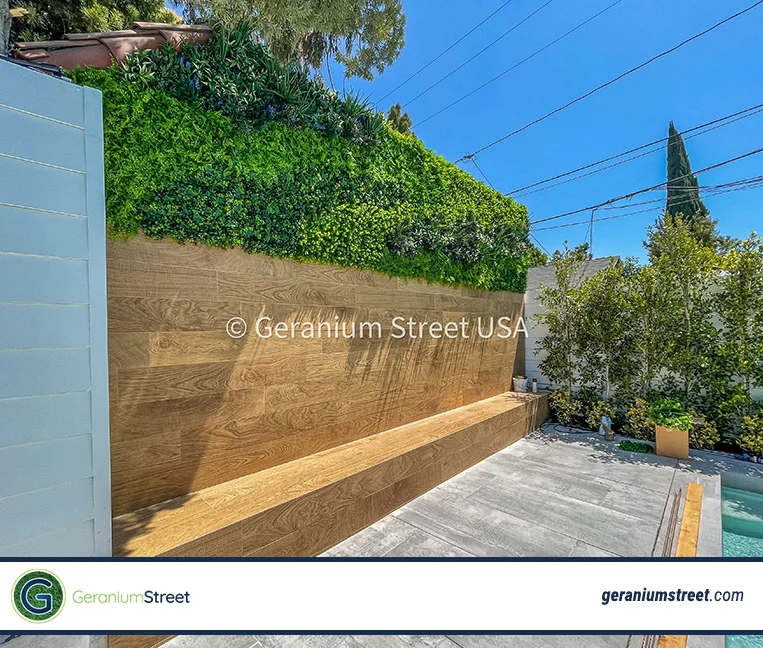
An existing residential wall received a finished greenery face rather than being removed and rebuilt.
View project →The exact substrate and selected product remain authoritative over broad installation language.
They can be considered for chain-link and other open-mesh fences when the existing structure is suitable. Tie or clip material, spacing, edge restraint, wind exposure, gate movement, and product format must be reviewed for the project.
Possible attachment paths differ by substrate. Wood may use rails or a secondary backing; metal may use ties, clamps, or a frame; masonry commonly needs furring, a support grid, or anchors selected for the actual substrate by the installer.
No. Artificial greenery is cladding, not structural repair. Posts, rails, mesh, fasteners, anchors, gates, and adjacent construction should be assessed before adding product, attachment hardware, or wind area.
Use the dedicated boxwood-mat calculator with the fence width and height, then add an allowance for cuts, openings, edges, overlaps, and field conditions. The final order should be checked against the exact product and layout.
Geranium Street provides product selection, specifications, quotes, and nationwide shipping support. California installation is handled by Califauxscapes. Outside California, local installation scope and responsibility are confirmed for the project.
Applicable products may have product-specific fire documentation. The exact material must match the documentation submitted, and the venue or authority having jurisdiction decides whether it is acceptable for the project.
Send the full fence or wall, close views of the support and damage, dimensions, gates, exposure, location, desired finish, and any reviewer requirement. Current product, price, freight, availability, and installation path are confirmed from the project.