Introduction
If you’ve been looking up Artificial living walls and Artificial hedges in New York, you’ve probably run into the same two options over and over: cheap “green wall” panels that scream plastic once you’re a few feet away, and premium installs that feel like they’re priced for someone else.
New York, NY also brings its own constraints—co-ops with strict rules, rooftops that bake in summer and get hammered in winter, and commercial spaces where “yeah, it’s fire-rated” isn’t enough without paperwork.
This guide is here to make the choices clearer. We’ll cover where artificial living walls and artificial hedges work well in NYC (and where they don’t), what “fire-rated” actually means, what installation really looks like, and the very New York mix of wind, salt, soot, and seasonal swings that can change how a wall or hedge looks after a year.
You’ll also get a simple way to start: how to measure, what to build time into, and what to ask a product supplier before you sign off on a product configuration.
New York artificial living wall and hedge project planning
New York doesn’t buy greenery the way suburban markets do. Space is tight, neighbors are close, and anything that looks cluttered gets noticed. So custom artificial living walls and custom artificial hedges tend to show up in specific NYC situations where they solve a real problem.
In residential settings, artificial boxwood hedge panels are common as privacy screens on balconies in Williamsburg and Long Island City, where you might be staring straight into the next building’s windows. A dense hedge (often 20"–40" tall when used as a railing screen) can give you separation without eating up floor space the way planters do.
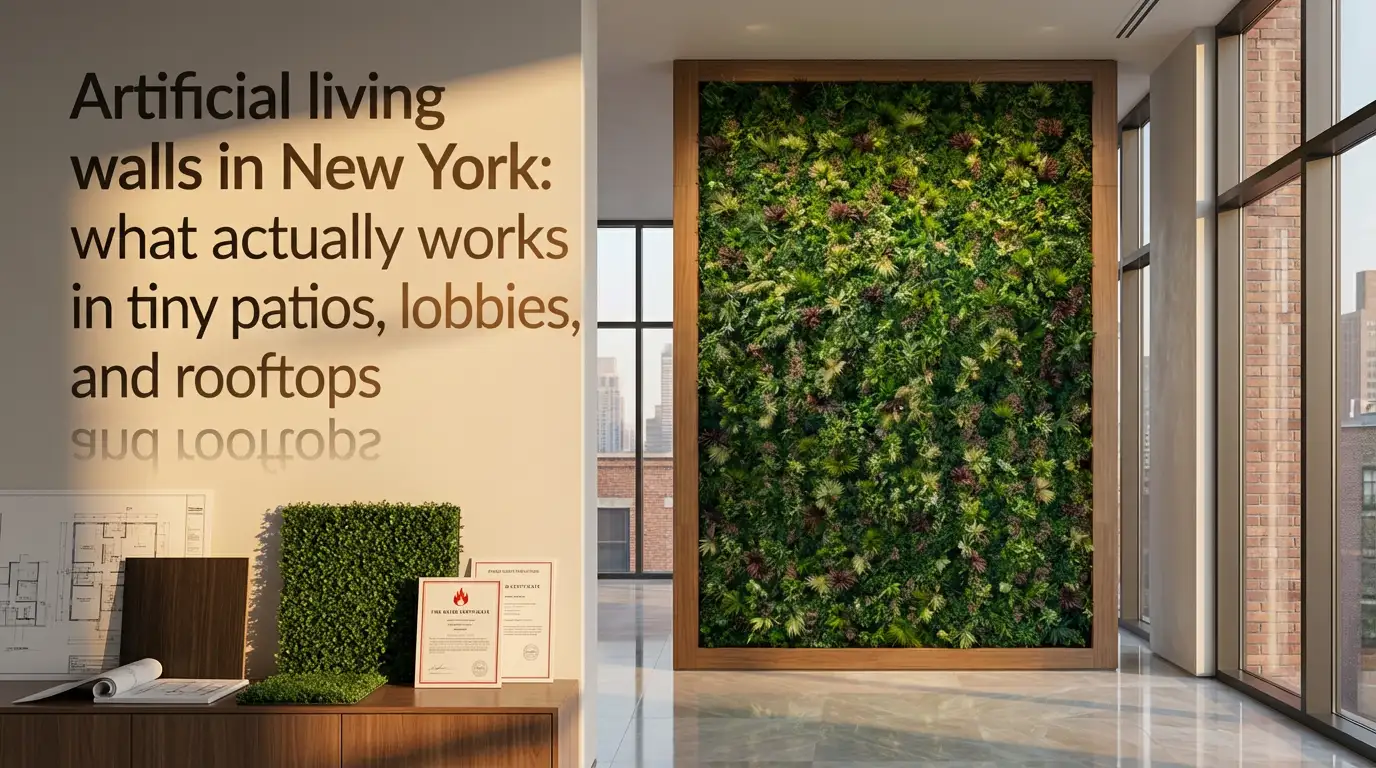
In Manhattan, artificial living walls usually end up indoors: lobby backdrops, elevator alcoves, reception areas, amenity rooms. It’s mostly practical—many buildings want a controlled look without irrigation lines, drainage risk, or the ongoing shuffle of replacing live plants. And in interiors with little or no natural light, live plants can become a constant maintenance loop.
For hospitality, you’ll see faux living walls and hedges around seating zones and photo moments—especially near heavy foot traffic like the streets around Madison Square Park. The driver isn’t only looks. It’s speed. A modular wall or hedge mat system can often go in without watering systems, grow lights, or waiting months for plants to establish.
One thing NYC buyers often realize late: the best-looking installs usually aren’t the ones with the “most leaves.” They’re the ones with better leaf variation, more believable color (not neon green), and clean finish work—trimmed edges, hidden seams, and corners that don’t puff out.
Where artificial hedges show up most in NYC
Artificial hedges in New York, NY usually land in the same three scenarios.
First, balcony and terrace privacy. Railings on mid-rise buildings where you want screening but can’t bolt heavy structures into shared building elements.
Second, rooftop wind breaks. Rooftops around Chelsea and the West Side get real gusts. A hedge can work as a visual buffer, but it needs proper mounting so it doesn’t act like a sail.
Third, interior zoning. In open-plan offices and studios, freestanding hedges (or hedge panels built into a frame) can break up space without permanent construction.
Where artificial living walls win in NYC
Artificial living walls make sense when you want a strong visual feature without the building complexity of a live system. Think common areas, retail walls, gym backdrops, and anywhere you want a consistent look through winter—when heating season and low humidity can be rough on live plant displays.
Why New York residents and businesses choose artificial living walls and artificial hedges
Most people start with the same question: “Could live plants work here?” In New York, NY, the answer is often “maybe, but the building will turn it into a project.” Artificial greenery is usually the cleaner option once the constraints stack up.
You don’t want irrigation, drainage risk, or weekly plant care
Live green walls can look great, but they’re still systems: pumps, reservoirs, timers, drains, waterproofing, and a maintenance plan. In a NYC apartment or commercial interior, one leak can become a building-wide headache. An artificial living wall sidesteps that whole category of risk. No irrigation lines behind drywall. No water stains. No routine pest treatments. You still have basic upkeep—dusting indoors, an occasional rinse outdoors—but you’re not maintaining something alive.
You need privacy without sacrificing floor space
If you’ve tried to create balcony privacy with planters in New York, you know the trade-off. Planters eat usable space, they get heavy when wet, and plants don’t always make it through the season. A faux hedge as a railing-mounted screen is much slimmer. Many hedge panels are about 1"–2" thick, so you keep your walking space and still get the coverage.
You want something that still looks like “summer” in February
New York winter drags on, and exterior live plantings can look rough by late February. Artificial hedges and faux living walls keep the same look through freeze/thaw cycles. That consistency is a big reason they’re used in hospitality and retail—your space looks intentional all year, not just when it’s warm out.
Commercial spaces often need fire documentation
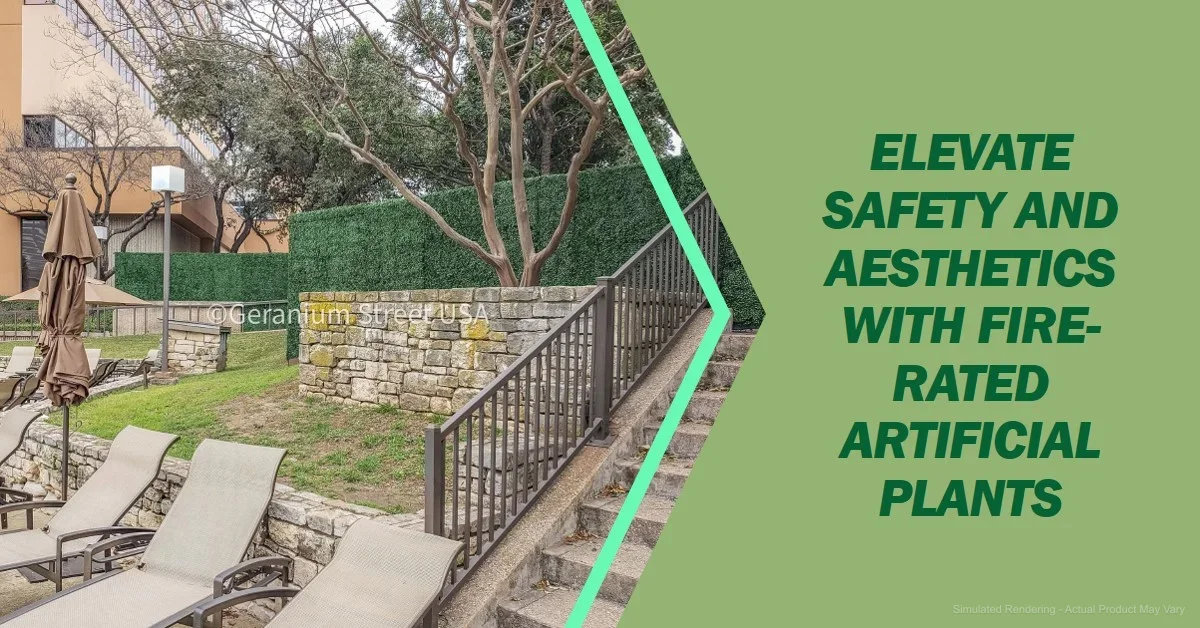
If you manage a lobby, restaurant, event space, or office in New York, the conversation can turn quickly to code and paperwork. “Fire-rated” can’t be a hand-wave. For certain commercial interiors, you may need artificial greenery that’s NFPA 701 Method 2 certified (a flame propagation test used for textiles and decorative materials). Some Geranium Street products are available with that certification.
What to look for in a New York product supplier (so the install doesn’t look like a DIY panel wall)
A lot of people order hedge mats or faux living wall tiles online and plan to install them themselves. Sometimes that’s totally fine—especially for a small balcony run. But NYC installs get complicated fast, and the difference between “cheap-looking” and “clean” is almost always in the prep work.
Ask how they handle seams, edges, and corners
In NYC, you’re often installing against very straight, very visible surfaces: painted drywall, glass, steel columns, fence lines that run the length of a terrace. A good product supplier should be able to explain: This is also where custom artificial living walls can be worth it. Custom work can blend multiple foliage types and shift density where your eye actually goes—around eye level, entry points, and seating areas.
Get specific about mounting (especially on rooftops)
NYC rooftops and terraces are where bad installs show up first. Wind load is real, and landlords don’t want random penetrations into shared structures. Before you commit, ask what the mounting plan is for your actual surface: If the plan is basically “we’ll zip-tie it and hope,” take that as a warning.
Confirm UV stabilization for outdoor NYC installs
Outdoor artificial hedges and walls in New York, NY deal with hard sun in summer and long cold stretches. UV stabilization helps slow fading and brittleness. For any terrace, rooftop, or exterior façade, you’ll want UV-stabilized materials. One realistic expectation: outdoor installs last longer when they aren’t in full-day direct sun and when they get cleaned once in a while. A south-facing rooftop with no shade is the toughest version of this.
Know when you need a fire-rated product
For many residential installs, fire-rated products may not come up. For commercial interiors, they often do. If you’re fitting out a lobby wall in Midtown or a restaurant interior near busy corridors, ask early: do you need NFPA 701 Method 2 certified artificial greenery for this application? Requirements can vary by building, occupancy type, and how the greenery is classified (decor, wall finish, etc.). Your GC, architect, or building management may also have a standard.
Look for material realism, not just density
If you want it to look believable, ask for close-up photos in real lighting. You’re checking for: In NYC interiors—especially under bright lobby lighting—gloss and repetition show up immediately.
New York area-specific considerations (wind, winter, and the stuff that ends up on your wall)
New York installs come with a few “only here” headaches. None are dealbreakers, but they should steer product choice and how the install gets done.
Freeze/thaw and winter brittleness
New York, NY gets real winter swings. Materials expand and contract. If hedge panels are mounted too tightly with no room for movement, you can end up with buckling or fasteners popping out. On terraces and rooftops, it’s smart to mount in a way that holds firmly without stressing the panels. And it’s worth avoiding ultra-thin bargain panels that get brittle during cold snaps.
Wind on rooftops (especially higher floors)
Rooftop hedges are common in places like Long Island City, where new buildings have shared outdoor amenity decks. But wind up there doesn’t behave like wind at street level. If you’re installing an artificial hedge as a railing screen, think about airflow. A super-dense hedge catches more wind. Sometimes a slightly more open pattern or reinforced backing gets you the look without the sail effect.
Soot, dust, and city grime
This doesn’t get said enough. New York air leaves a film—especially near busy avenues, bus routes, and construction. Indoors, it shows up as dust sitting in the leaf texture. Outdoors, it can dull the finish. The fix is simple: occasional rinsing (a garden sprayer works) or a gentle wipe-down for interior walls in lobbies and offices. If you’re near major traffic corridors—close to Broadway or near bridge approaches—expect to clean more often than you would on a quiet side street.
Building rules, co-op approvals, and installation access
A great product can still turn into a hassle if your building requires: If you’re in a co-op in Manhattan or Brooklyn, ask management what they need before installation day. It can add a week or two to scheduling even if the install itself is finished in a day.
A quick note on local numbers (so you can sanity-check scale)
New York City has roughly 8 million residents (U.S. Census Bureau estimates put NYC around 8.3 million in recent years). That density is why privacy and visual screening come up constantly—your outdoor space is usually in full view of dozens (or hundreds) of neighbors.
Getting started with artificial living walls and artificial hedges in New York
Most NYC projects go better when you start with the basics: measurements, surface type, and what you need the wall or hedge to accomplish.
First, measure in inches, not just feet. In New York, you’re usually working inside tight constraints: a 92"-wide balcony bay, a 34"-tall railing, a lobby niche that’s 118" up to the sprinkler line. Those details drive panel layout and where seams land.
Second, decide if you want coverage or design. If you need a uniform hedge look for privacy, hedge panels are usually the simplest path. If you want a statement behind a reception desk, a custom living wall with mixed foliage tends to look more natural and hides seams better.
Third, confirm whether the install is indoors or outdoors, and whether it’s commercial. That tells you if you should be looking at UV-stabilized materials, or fire rated living walls where the product is NFPA 701 Method 2 certified.
If you want help scoping it, Geranium Street typically starts with photos of the space, rough dimensions, and a quick conversation about mounting surfaces. From there, you can pick between DIY-friendly panel systems and product configuration when the finish details really need to be tight.
Conclusion
NYC projects tend to go well when you focus on realism and the unglamorous planning. If you want Artificial living walls and Artificial hedges in New York, keep your attention on three things: materials that hold up under close inspection, mounting that matches your building surfaces (and your rooftop wind), and the right documentation when fire-rated products are part of the spec.
If you’re ready to price out a wall or hedge for an apartment balcony in Williamsburg, a rooftop in Long Island City, or a commercial interior near Madison Square Park, Geranium Street can help you choose panels or build a custom artificial living wall that fits the space and the rules that come with it.